Monday, September 14, 2020

Lost locks, a banana bonanza and an uplifting end to our Weaver excursion.

I really, really should get back to blogging more regularly. Then you won’t have to lose an hour of your life reading what is shaping up to be another long, rambling post!

Right then, where were we? Ahh yes, Sutton Bridge, last Tuesday. We took the day off as intended on Wednesday, Amber and I had a walk up river to see what there was still to see of Sutton Locks. Not a lot as it happens.

Sutton Locks were built as the entrance to the Weston Canal to protect the water levels in Weston Point and Runcorn Docks. Frodsham Lock had been in existence for several years before the Weston Canal, maintaining a navigable head of water above the tidal estuary. But I’m guessing that it’s associated weir wasn’t high enough to cope with seasonal flooding and high spring tides, so Sutton Locks acted as a barrier to these variable levels. Interestingly the two adjacent and different-sized chambers had pairs of opposing gates so that boats could lock up or down from the canal depending on the river level.

Using the excellent mapping system on the National Library of Scotland (https://maps.nls.uk/geo/explore/#zoom=16&lat=53.30215&lon=-2.69697&layers=6&b=1)you can see the original arrangement and the current situation…

From 1898…

…and now

The locks are to the right if you’re struggling, clearly marked on the OS map.

The locks are now buried in the trees and bushes in the bend of the channel, and the spit of land separating the locks from the weir stream is considerably shorter. With the opening of the Manchester Ship Canal in 1894 the Weaver Estuary was no longer tidal so Sutton Locks were no longer needed. The channel to the south-east of the locks was opened up, removing a good lump of the lock island. The locks were left to gently decay into oblivion. But not before they were joined by several old, redundant work boats, some narrowboats, some Mersey/Weaver flats. These versatile cargo vessels were the mainstay of the carrying fleet on the Weaver and up and down the Mersey, sail driven in the open waters and drawn by a team of men or draught animals in confined channels. As trade decreased and moved to larger, motor-driven boats the old ones were decommissioned and often left to rot in out of the way places. One of these graveyards is the disused lock cut at Sutton.

1975 Image purloined from https://www.gooseygoo.co.uk/site/mersey-flat-daresbury/

One of these sits in the chamber of the small lock, closest to the towpath. It’s the corpse of Daresbury, built in 1772 and used on the Weaver for coal carrying. She was still in use in 1956, there’s apparently a photo (that I can’t locate…) of her in Northwich at that time. By 1985 she was no longer needed and was sunk in the lock chamber and left to rot. A survey was carried out by Navy divers with a view to raising and restoring the hull, but it was found to be too far gone.  

There’s very little to see now, it’s probably clearer in the winter when the foliage has died back, but there’s only barely visible copings to spot from the towpath. And a bit of the timber of the old Daresbury.

The transom, I think.

flooded hold…

…and ironwork off the fore end.


The reed bed obscures all of the other craft dumped in the cut.

On Thursday morning we made the trip back upriver, not all the way, just up Dutton Lock and stopping at Acton Bridge.

Dutton Railway Viaduct

Bridge over Dutton weir stream.

Amber relaxing aboard…

…and ashore.

We had a Tesco delivery scheduled for arrival at three o’clock on Friday and it arrived handily. It was only after the driver had left and we were unpacking that  realised that the six bananas I’d ordered actually turned out to be six packs of six!

That’s a lot of bananas!

We do like bananas, but for breakfast dinner and tea for the next week would have been too much, so I separated them, wrapped the stems and stored them in the cool of the wine cellar.

It’s supposed to keep them fresh for a fortnight. We’ll see…

In the evening, after packing away the groceries and filling the water tank we left the noisy environs of the bridge and moved up to the peace and quiet below Saltersford Lock.

Approaching Saltersford Lock on a beautiful evening

Saturday saw us up the lock in company with another three boats, and stopped on the grass at the nature park just past the lift for the weekend. This morning was our last on the river for a bit, our passage up the boat lift was booked for 11:30 and we went up with another boat.

Heading for the lift

Passing the down caisson at the halfway point.

At the top we swung right and slotted into a gap just vacated by someone going down. How lucky was that!

We’d only been tied up for a half hour when Halsall came chugging along so I flagged them down, filled the fuel tank and swapped an empty gas bottle.


We’ll head back towards Middlewich tomorrow.

Locks 2, miles 10½

Tuesday, September 08, 2020

To Frodsham and beyond!

It’s been an uneventful week, we headed down to Acton Bridge last Thursday as planned, meeting Brian from Four Counties Fuels for some solid and liquid fuels, delivered by van the following day. That loaded we toddled off back upstream to moor below Saltersford Lock, away from the constant traffic over the bridge.

On Saturday morning we were off early (for us) and up Saltersford Lock by half-nine.

Instead of stopping at Anderton we pushed on, through Northwich to moor below Hunts Lock. Although it’s further from the shops in the town centre it’s a far more pleasant mooring than Barons Quay pontoon or opposite the marina.

I had a bag of Amber’s dog food to collect from a Hermes parcel shop in the afternoon, then a few bits and pieces from the local Waitrose.

The small lock at Hunts comfortably takes three narrowboats abreast.

Vale Royal is the same, with the smaller of the two the only one usable. Downstream it  swaps around and the large chambers are in use at Saltersford and Dutton.

Yesterday (Monday) we moved the short distance out of town downstream, slotting nicely into a gap just upstream of the boat lift.

Overtaken by Spey before we turned around to moor.

Amber and I had a pleasant walk up in the nature park this morning before  we were off again, downstream still to catch the ten o’clock locking at Saltersford. With the current passage restrictions you have to plan ahead a bit.

Winsford Bridge is undergoing repairs to strengthen the structure.

When it was built in 1910 traffic was a lot lighter in both volume and weight…

Approaching Saltersford Lock.

We shared the 237 x 37 foot chamber with just one other boat… Unlike those above Northwich which will take three narrowboats, these two downstream will accommodate 15!

Passing Acton Swing Bridge, pivoting in the middle as the two arms cross the navigation and the backwater moorings used by Acton Bridge Cruising Club.

This is the furthest downstream we’ve ventured so far this trip.

Dutton Sluices ahead, with Dutton Lock around the corner to the left.

Poor old Chica is looking even more forlorn after last year’s floods.

It’ll not be long before the wheelhouse slips off into the river.

Below Dutton Locks the navigation passes the elegant laminated bridge carrying the towpath over the backwater and then under the substantial sandstone viaduct carrying the West Coast Main Line.

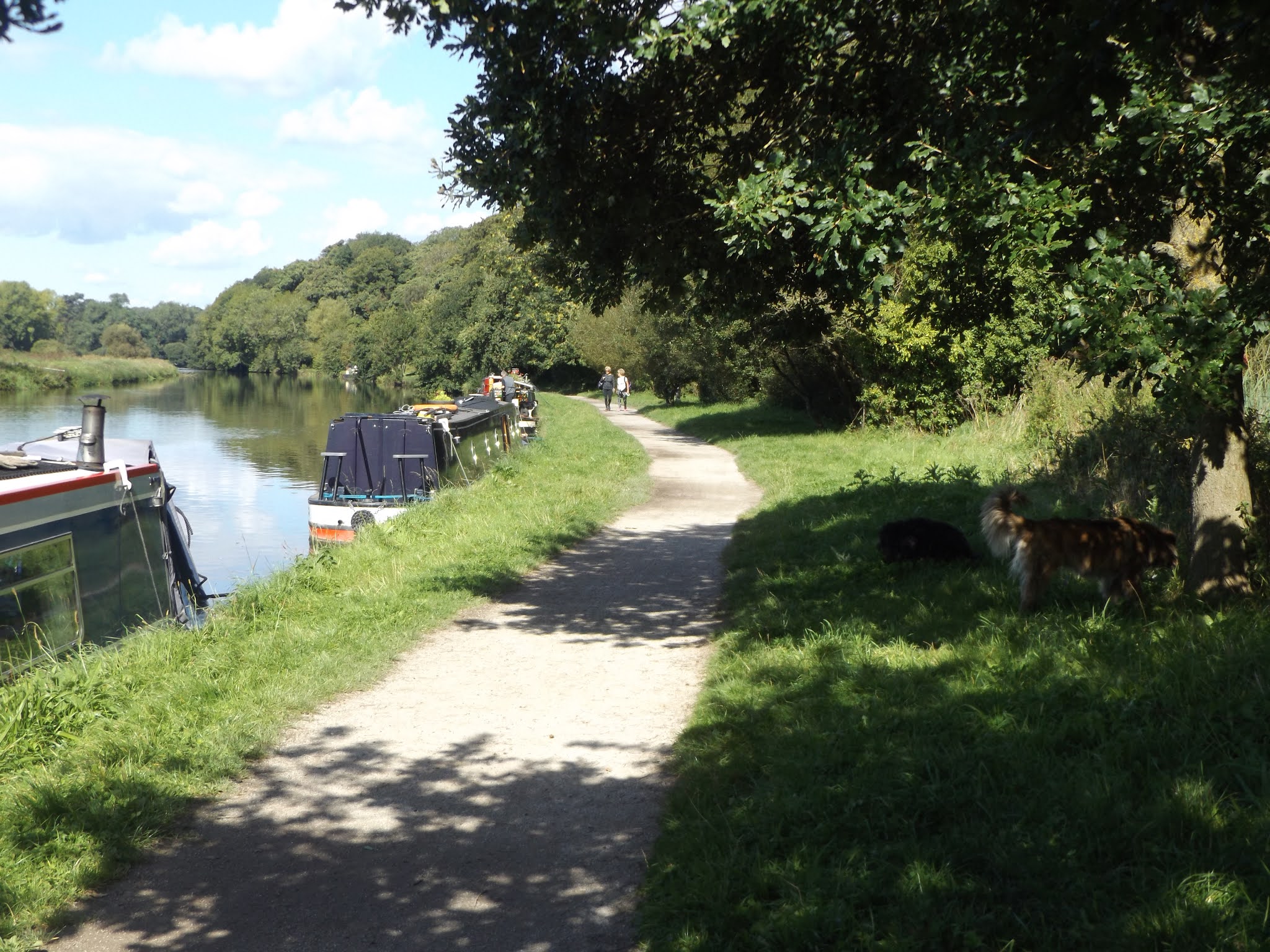
From here to Sutton Bridge is the prettiest section of the navigation, passing through meadows and woodland with only the odd farm to be seen.


For the trip back upstream I’d thought about having a night at the quiet rough mooring at Devil’s Garden. But I’m not sure how Amber would cope with the cows…

A couple of changes in the development of the navigation can be seen as it approaches Frodsham.  The sharp bend on the river was bypassed early on by the construction of Frodsham Cut and Lock which then rejoined the now-tidal river on it’s way to the Mersey Estuary.

Frodsham Cut to the left.

In 1853 the Weston Canal was completed, allowing vessels to avoid the final section of the river and run down to Weston Point Docks and to the Runcorn and Weston Canal which connected through a flight of 10 locks up to the the Runcorn Arm of the Bridgewater Canal.

Onto the Weston Canal.

Finally, in 1894, the Manchester Ship Canal was opened and the docks connected to the new waterway. Subsequently a further lock was constructed at Weston Marsh to allow vessels to join the MSC from the Weston Canal without going through the docks.

Sutton Swing Bridge, with the railway viaduct in the background.

After passing under the M56 bridge and the Runcorn Rowing Club headquarters the right (east) bank becomes home to a large chemical works which flanks the navigation all the way to the current end of the navigation.

We pulled in at Weston Marsh Lock for lunch and for Amber and I to have a nosey round…

Looking out over the water – The Weaver coming in from the left and the Manchester Ship Canal from behind the spit of land in the centre before heading up to Manchester to the right. The Mersey Estuary lies beyond the far bank.

It’s not easy to see much from such a low elevation, so here’s a satellite view courtesy of Google Maps.

Weston Marsh Lock is in the centre.

Maintenance work on Weaver Sluices, a half-mile away across the MSC.

After lunch we cruised the last mile to the current end of the navigation at Weston Point.

Under the locked swing bridge is Weston Point Docks, now no longer accessible

The derelict entrance lock to the Runcorn and Weston Canal.

The R&W ran for almost 1½ miles to Runcorn Docks and the connection to the bottom of Runcorn Locks. There’s considerable enthusiasm for re-opening the canal and the locks, thereby forming a cruising ring involving the Trent and Mersey, Bridgewater and Weaver Navigation. Unfortunately there’s little funding for a project of this scale.

We returned back up the canal to Sutton Bridge and pulled in for the night.

This has been our longest cruising day for some time, 5 hours, 16½ miles and two locks! Easy trip though.

A day off tomorrow then we’ll head back upriver on Thursday. We’re booked back up the boat lift on Monday morning.

Since last post – Locks 3, miles 24¼

Wednesday, September 02, 2020

Heading downstream

 Even though it was a Bank Holiday weekend, it was fairly quiet at the moorings in Winsford. Well, apart from the bit of boat rage on Sunday evening. The crews of three boats (two on one side and one on the other) came to blows over poor behaviour out on the flash in the afternoon. A spectator called the police but it was decided that it was six of one and a half-dozen of the other and they left without charges being laid. Still, it gave us a bit of entertainment…

Talking of entertainment, the Weaver Way along the river valley is popular with dog-walkers and Amber had plenty of opportunity to have a run around.

Meeting Benji…


…and they’re off!


We pushed across to fill with water then headed off around mid-morning Monday, back down to the Vale Royal moorings.

Cautiously edging out a hundred yards into Winsford Bottom Flash to turn around…


We moved back onto CRT water at Winsford Town Bridge.


There’s a silted and weed covered loop off to the west, running around the back of the site of Meadows Salt Works.

The straight cut the channel follows now passed Meadows on the left and Birkenhead and Uploon’t works on the right. Between Wharton Road Bridge and Newbridge a 1909 OS map shows 17 individual salt works along the line of the river. All gone now apart from Meadowbank.

Newbridge Swing Bridge is actually the site of one of the eleven early locks from when the river was first impounded and made navigable around 1732. Various phases of improvements as trade developed have led to there being only 5 now, including Marsh Lock dropping down onto the Manchester Ship Canal. Originally 40 ton barges were hand hauled or towed behind steam tugs, after the final reconstruction 1000 ton coasters were able to reach Winsford.

Moored for the night at Vale Royal, Amber and another boat dog Milly relaxing in the shade.

Yesterday we took the second sitting, dropping down Vale Royal Lock at half-one. There were several boats heading down so we left the half-ten locking for those wanting to press on.

Waiting for the lock to be readied.

We were dropped down Hunts after the 35 minute cruise under Hartford Bridge and past Jalsea Marine’s eclectic mix of moored boats and pulled in on the bank just below.

We were alone for a start but the small cruiser Trilogy arrived a little later.

After a quiet night and a morning walk up the offside bank of the river we moved on, under the two swing bridges and out of town towards the boat lift. The moorings in the town and at Baron’s Quay, but everyone seemed to be moored instead at the bottom of the lift so our plan to moor there was out of the window.

Ever patient angler giving us a wave as we pass..

Instead, we carried on, under Winnington Bridge and onto Barnton Cut. 

Winnington Salt works has been completely demolished now, and the housing development already started.

But a bit of history still remains, the names of boats that once loaded here, painted on the wharf wall by their crews.

Since the works closed though the local oiks have added their own visiting cards…

Our single-boat-sized slot was occupied so we moved on a little way to find the main moorings on the cut empty. We were joined shortly afterwards by another boat. Then it started to rain…

The locks are manned again tomorrow so we’ll head down Saltersford in the morning, hoping to get moored at Acton Bridge.

Locks 2,  miles 8¾