This post is a day late, I'm afraid. We've problems with uploading pictures into Blogger... again. There's a tedious work-around. But it takes time.
We pushed on from the moorings above Cromwell Lock on Tuesday morning after topping up the water tank.
Leaving Cromwell Lock on a fine but chilly morning.
That’s the CRT tug
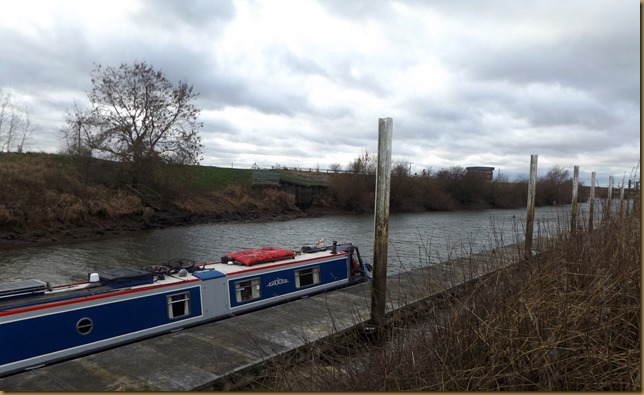
Maid Marion tied up on the pontoon.
On the tidal reaches above Cromwell the villages stand well back from the river, up here where it’s at least partially tamed they approach the waters edge, somewhat tentatively behind high flood banks.
North Muskham
Approaching the A1 road bridge jus t to the north of Newark.
The busy road used to go through the town, which must have been a nightmare!
The A1 swings around Newark to the east, and the river swings around to the west.
The Newark Dyke was opened in 1772 to provide the mill-owners and warehouses with direct access to water transport. This is the navigable route through the town, bypassing the shallows and weirs of the old route through two locks. There’s an interesting article about how the streams developed
here.
Just above the bridge is Crankley Point where the river and the navigation re-unite.


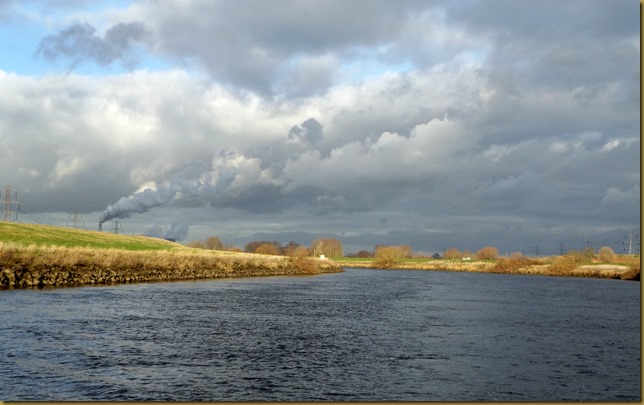
The smoke (and smell…) is from the stack of the sugar beet factory.
Newark Nether Lock protects the Dyke from the varying height of the river to the north of the town. It’s quite deep and is the first of the large Trent locks Mags has had to deal with.

After the barge locks up in Yorkshire these don’t bother Mags at all. The only difference is that we’re going up rather than down.
We were hoping to get onto the floating pontoon outside The Kiln and were lucky to have space right on the end.
Following on from Mags’ and Meg’s “issues” while we were up north, we’d agreed to get blood tests done for both of them after about a month. Newark was an ideal spot for this; a local hospital with a phlebotomy clinic and a vet 1o minutes for the moorings. I’d an appointment for Meg on Tuesday afternoon, and the vet was very thorough. They’d got Meg’s recent history from Ashland’s in Skipton, so knew what to look for. Samples were taken and analysed and the results show that Meg is now completely clear of any infection. There are still some issues associated with the medication for her arthritis, and her age, but generally she’s doing ok.
My other girl, Mags, had to go to Newark Hospital on Wednesday morning. We’ve good friends in Newark whom we met through boating, and they invited us to lunch. But first Dave collected us and took us up to the hospital for Mags’ blood-letting. Then we had a very enjoyable afternoon at Dave and Barbara’s home catching up.
Yesterday afternoon they came to us for tea, cakes and cookies, and we had another good natter.
This morning it was time to push on again. After a frosty night we had high cloud, masking any heat from the winter sun. I’d topped up, the cupboards from the handy Morrison’s and Waitrose supermarkets, so we were away before 10:00.
A very nice converted Dutch Tjalk launched in 1892.
I bet she’s got some tales to tell!
A little Dutch influence in the design of Muskham View’s clock tower, too!
Newark Trent Bridge, with the remains of Newark Castle beyond
And from upstream
In 1216 King John died here after a short illness. He hadn’t had a good month, a few days before his baggage train containing valuables, jewelry, fine clothes, embroideries and the like, was lost while traversing the salt marshes around The Wash. Apparently the waggoneers got lost in mist and the train was drowned in the incoming tide. The treasure is still out there, despite many attempts to find it.
I’d already put Mags on standby, expecting the Town Lock to be on self-service, and it was, with the traffic lights on amber. But as I walked up to set the lock a CRT lady doing some tidying up around the lock volunteered to do it for us. I accepted the offer quickly before she had a chance to change her mind. So we were through with a minimum of fuss, and Mags could stay inside.
In to Newark Town Lock…
…and out the other end.
The dyke runs for another 2 miles before it rejoins the river at the large Averham Weir.
The weir is a good spot for cormorant spotting, or from the other point of view, boat spotting!
The exhaust stacks of the gas-fired Staythorpe Power Station rise above the trees.
Near Farndon the elegant sweeping lines of another converted Tjalk contrast sharply with the utilitarian floating shed of a houseboat.
Egyptian Geese
Fiskerton stands next to the river, but has made sure that the river stays where it belongs with a high wall of steel piling.
There’s a short public mooring pontoon here, below the pub.
The course of the river follows a large loop above Fiskerton, enclosing the rising ground below East Stoke. It was here that the last, decisive battle of the Wars of the Roses was fought. Two years earlier, in 1485, Richard III had lost his life while defending his crown from the upstart Tudor, Henry, at Bosworth Field. Henry didn’t delay in getting himself crowned, but supporters of the House of York were still causing unrest, rumblings of discontent heard throughout the kingdom despite a program of imprisonment and execution of anyone suspected of supporting the deposed and murdered king.
Rampire Hill, site of the Battle of East Stoke 1487.
Various skirmishes through the following months led to one final set-piece battle here at East Stoke, that would decide the future of the monarchy. The Plantagenet Dynasty had provided 14 kings over the previous 350 years, but the line ended abruptly at and after Bosworth.
The Yorkists had raised an army of around 8000, including Irish infantrymen and German mercenaries. After two successful but minor engagements with Tudor forces, they finally met the full force of Henry’s army. Outnumbered and under-equipped, the Yorkists were defeated after 3 hours of intense combat. The survivors broke and tried to flee but many were caught in the loop of the river and cut down. All bar one of the defeated commanders died with their troops. Henry VII was now secure and the Tudors reigned in England for the next 116 years, until the death, without an heir, of Elizabeth I.
Hazleford Lock is just a little further along, and we’d planned to pull in below to give Meg a stretch of the legs, and for both of the humans to grab a cup of soup before doing the lock. But the lights were on red and then changed to red and green, indicating that there was a lockie on duty and the lock was being prepared for us.
Like at Newark, there was a CRT lady doing some basic ground maintenance, keeping an eye out for boats as she worked. I did pull in while the lock was emptying, lifting Meg off and up onto the grass so she could have a quick wee then back aboard ready to go in.
Going in to Hazleford Lock.
We did tie up temporarily on the high wall above the lock for a human comfort break, but inside 15 minutes were on our way again
.
A cormorant takes flight as we get too near.
Between Hazleford and Gunthorpe Locks the Trent Hills start to rise on the east bank.
On the opposite bank the fertile flat arable land stretches away across the broad valley. The village of Hoveringham lies over that way, as do large expired and water-filled gravel pits. The company that extracted massive amounts of sand and gravel from the valley floor was named after the village.
The Hoveringham Gravel Company started removal of the deposits in 1939, and had a mammoth logo on the trucks after mammoth fossils were found on one of the sites. I had a Dinky toy of one of their Foden tippers…
A covey of pochard get panicky as we come alongside
Gunthorpe Lock was next, and we were out of luck here, with no-one in CRT gear to be seen. Ah well, 2 out of 3 ain’t bad.
Mags waiting for me to set Gunthorpe Lock
It’s awkward here, the flow from the large weir tries to push you off the landing. Or, if you go on the other side, you can’t get off! The wall opposite is a good 12 feet high with ladders.
Mags in Gunthorpe Lock
After the lock we’d planned on mooring on the visitor pontoons around the corner. I didn’t expect it to be full, and in fact it was nearly empty.
The bridge in the distance carries the A6097 Lowdham Road and is the only road crossing between Nottingham and Newark.
We’ll head to Holme Lock tomorrow, mooring above the lock for Sunday, then into Nottingham on Monday. That’s the plan, anyway.
Locks 4, miles 19 (two days)